


Nature - 2019 June - Vol 570 No 7760
Publisher: Nature
Format: Paperback
ISBN: 9770028083095
There are magazines that discuss relationships in the usual human sense. Nature – June 2019, Vol. 570 No. 7760 instead offers a “COMPLEX RELATIONSHIP” between immune signalling, vitamin B6, quantum unpredictability, dormant bacteria, and genetically ambitious mouse lemurs. Frankly, it makes ordinary dating seem refreshingly straightforward.
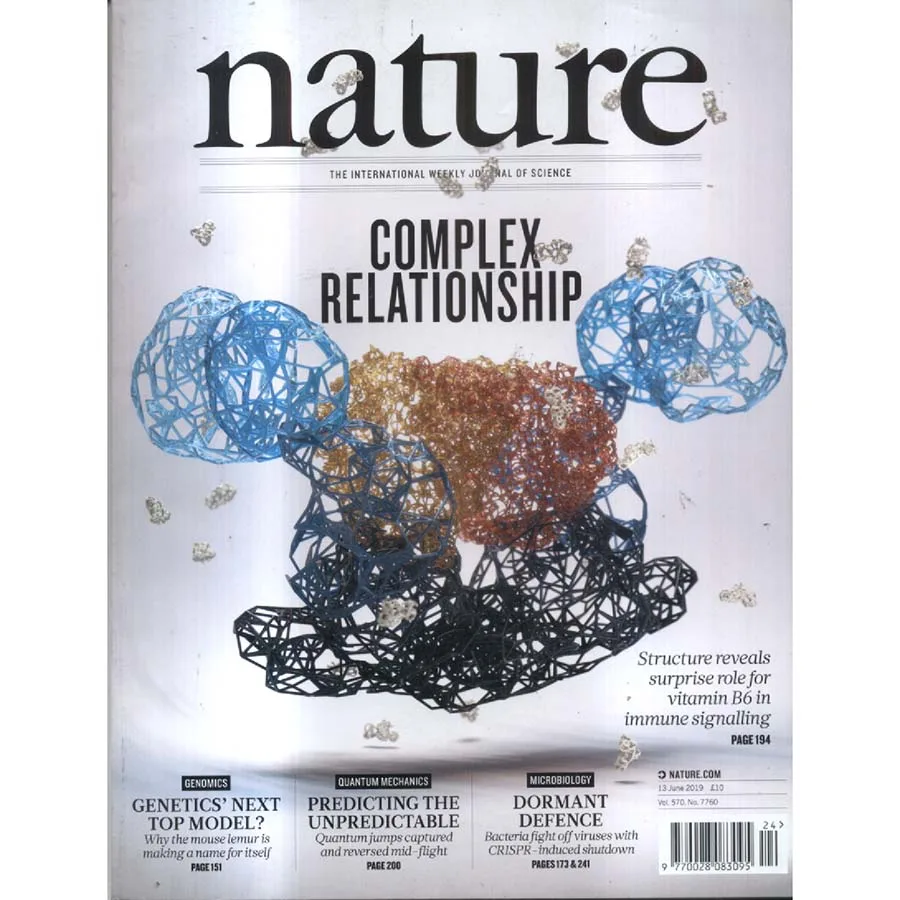
The cover artwork is peak Nature: abstract molecular structures floating in clean white space like avant-garde sculptures from a future where biochemistry has replaced modern art. Somewhere in these tangled geometric forms lies a revelation about vitamin B6 and immune signalling — a sentence which proves once again that even vitamins are secretly participating in highly complicated cellular dramas behind our backs.
The lead feature concerns structural biology uncovering a surprise role for vitamin B6 in immune processes. Which is deeply unfair, really. Humanity spent decades assuming vitamin B6 was quietly minding its own business in breakfast cereal, only for scientists to discover it has apparently been involved in sophisticated immune negotiations the entire time.
And naturally, because this is Nature, the issue immediately broadens into a magnificent buffet of intellectual instability. There are articles on predicting the unpredictable in quantum mechanics, CRISPR-induced bacterial dormancy, and genomics studies suggesting mouse lemurs are enthusiastically evolving themselves into multiple species. Every page carries the subtle implication that reality is vastly stranger and more active than previously advertised.
The quantum mechanics article is particularly delightful because it openly confronts one of physics’ favourite traditions: discovering that the universe behaves in ways that sound like the setup to a philosophical crisis. “Predicting the unpredictable” feels less like a research topic and more like the emotional state of everyone attempting to understand quantum theory after midnight.
Meanwhile, the “Dormant Defence” feature continues the late-2010s scientific pattern of bacteria turning out to be infinitely more sophisticated than humanity would prefer. At this point microbes appear to possess social systems, defensive strategies, communication networks, and perhaps better organisational skills than several governments.
Then there are the mouse lemurs, quietly evolving themselves into new species while nobody was paying attention. Evolution, as always, remains committed to running countless side projects simultaneously.
One of the enduring pleasures of Nature is its extraordinary editorial restraint. “Structure reveals surprise role,” it says calmly, while readers realise that even basic nutrients are involved in molecular systems more complicated than entire corporations. The magazine never shouts because the science is already dramatic enough.
Owning a copy of Nature also projects a very particular intellectual atmosphere. It suggests someone deeply engaged with frontier science and perhaps capable of discussing immune signalling pathways over coffee. Whether you actually read the structural-biology paper or simply admired the beautiful molecular artwork while feeling academically overwhelmed is beside the point. The magazine functions perfectly as both serious scientific literature and decorative evidence of ambition.
This June 2019 issue now feels especially evocative of the scientific mood of the era: biology becoming increasingly interconnected, quantum mechanics remaining gloriously uncooperative, and machine-assisted molecular discovery accelerating rapidly. Humanity was learning more every week, while simultaneously realising how little simplicity remained anywhere in nature.
Condition is listed as Good, meaning this copy has survived the standard hazards endured by elite scientific journals: overloaded backpacks, office desks buried in unread ambitions, coffee consumed dangerously close to important diagrams, and years spent in carefully maintained stacks labelled “must properly read later”.
An excellent issue for science enthusiasts, molecular-biology obsessives, quantum-curious readers, or anyone who enjoys magazines that casually combine vitamins, bacteria, quantum uncertainty, and aggressively evolving mouse lemurs into one beautifully intimidating package.
Keep browsing: See more Nature Journal books Other books by Nature
